Prediabetes Is Not a Warning Light—It’s a U‑Turn Opportunity
Jul 12, 2026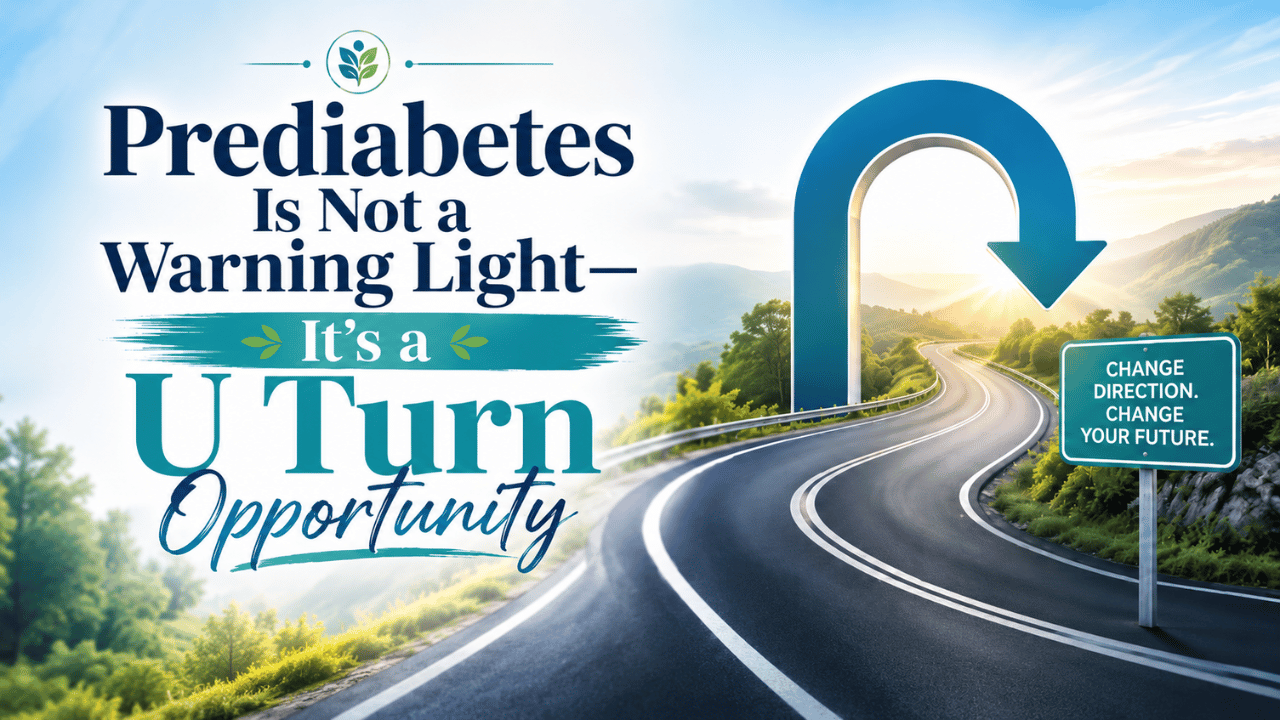
When “Borderline” Isn’t Benign
If you have been told you have “borderline” blood sugar or prediabetes, you did not receive a gentle warning; you were handed a fork in the road.
On one path, you accept a quick prescription, watch your numbers for a few months, and quietly collect more diagnoses over the next 10–20 years.
On the other path, you use this moment to fundamentally rewire how your body handles food, stress, and aging, and you change the story of your 60s, 70s, and 80s.
That second path is the one I help my patients take every single day.
The Truth About “Silent” Type 2 Diabetes
Right now, tens of millions of people are living with type 2 diabetes, and even more are walking around with prediabetes, many without realizing it.
That means if you are in a room with four adults, there is a good chance at least one person already has diabetes, and another is sliding toward it, often without symptoms dramatic enough to stop them in their tracks.
Type 2 diabetes rarely shows up overnight.
It creeps in as:
-
Afternoon crashes you blame on being busy
-
Extra belly fat you blame on aging
-
Brain fog you blame on stress
Under the surface, insulin resistance is eroding blood vessels, nerves, kidneys, eyes, and brain tissue long before the word “diabetes” appears in your chart.
The One Finding You Can’t Ignore
Let me give you the headline, not the spreadsheet.
A major, decades‑long study followed adults with prediabetes and compared three paths: intensive lifestyle changes, metformin, and placebo.
The lifestyle group ended up with fewer chronic conditions stacked on top of each other over time, while the metformin group did not beat placebo for that long‑term disease burden.
In plain language:
-
A pill improved blood sugar on paper.
-
Lifestyle changed the actual future, fewer diagnoses, fewer complications, less multimorbidity.
That is why I refuse to treat prediabetes as “just a number.”
Managing a Number vs. Changing a Trajectory
When your A1c creeps up, it is tempting to think, “If a pill brings that number down, the problem is solved.”
But focusing on the number alone is like repainting a rusting car, you may feel better looking at the dashboard, while the frame underneath continues to corrode.
Metformin can absolutely be appropriate and even lifesaving in certain contexts.
The issue is not the medication itself; it is the illusion that medication equals prevention, while lifestyle is “optional.”
The best evidence we have says the opposite.
Lifestyle is the main intervention. Medication is the adjunct.
What “Lifestyle” Really Means (And What It Doesn’t)
Here’s the part I want you to really see: in that landmark research, “lifestyle” was not exotic biohacking.
It meant:
-
Cleaning up the way they ate
-
Moving their bodies about 150 minutes per week
-
Losing a modest amount of weight, if needed
Even those broad, generic changes were powerful enough to beat metformin for long‑term disease burden.
Now imagine what happens when lifestyle is not generic at all, but precision‑tuned to your labs, your genetics, your history, and your life.
That is exactly where my work, and this upcoming webinar, lives.
Where Generic Lifestyle Stops and Precision Begins
I am not interested in telling you to “eat better and exercise more.”
You have heard that before, and if it was enough, you would not be reading this.
In my practice, we start with questions conventional care often skips:
-
Why is your metabolism struggling in the first place?
-
Is your liver overwhelmed with fat and toxins?
-
Is chronic inflammation driving insulin resistance?
-
How are stress, sleep, and hormones skewing your blood sugar curve?
Using your lab work, sometimes your genetics, and a detailed look at your history, we build a map of what is actually driving your prediabetes or early type 2 diabetes.
From there, we use food, movement, targeted supplements, and nervous‑system support as specific tools, not vague suggestions.
This is the heart of my Precision Empowerment Pathway™:
-
Precision – Labs and history guide every decision instead of guesswork.
-
Nutrition – Food is prescribed strategically to change insulin sensitivity, inflammation, and energy, not just calories.
-
Empowerment – You understand what is happening in your body and why, so you can make choices with confidence instead of fear.
-
Pathway – You get a stepwise plan, not a scatter of disconnected tips.
Your Turning Point Starts Before You Need a New Prescription
If you have ever felt your intuition whisper, “There has to be more than this pill,” you’re right.
Long‑term research backs you up: structured lifestyle change, not metformin alone, was what truly shifted the burden of disease over two decades in adults with prediabetes.
You do not need to wait for your next lab report to get worse.
You can choose a different trajectory now.
Overwhelmed by pieces of advice, not a real plan?
Dr. Laleh Talebian, Ph.D. helps you make sense of the fragments (labs, nutrition, strength, lifestyle, and the questions that still don’t fit together), then builds a clear, evidence-informed plan around your situation so you can take the next steps with more clarity, not more noise.
About the Author