Food Is Medicine, But What About the Container?
Sep 12, 2026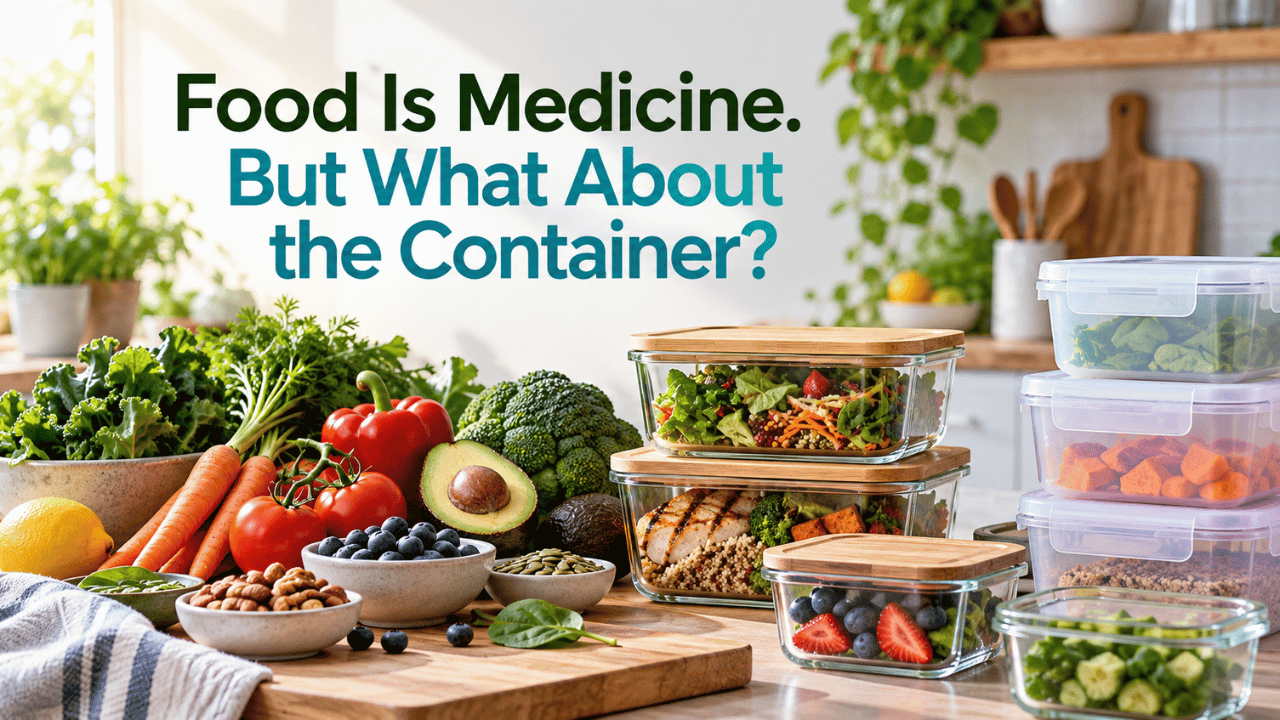
You've heard me say it a hundred times: food is medicine. But here's the piece most wellness advice leaves out: it's not just what you eat. It's what your food has been sitting in, wrapped in, and microwaved in before it ever reaches your plate.
New research is confirming something I've watched play out in lab work and health histories for years: plastic food packaging isn't a neutral bystander. It's a quiet, daily source of some of the most persistent chemicals ever created, and they're already inside almost all of us.
What the science just confirmed
A 2025 systematic review and meta-analysis in Environmental Science & Technology, conducted by researchers at the CDC's Agency for Toxic Substances and Disease Registry, pooled data from 74 studies on per- and polyfluoroalkyl substances (PFAS), the "forever chemicals" used in food packaging, nonstick coatings, and countless consumer products, two findings stood out to me:
- Geography barely mattered. Serum PFAS levels were remarkably similar across regions, the exception being communities near known contamination sites, where levels spiked higher. In other words, this isn't a "somewhere else" problem. It's a global, everyday-life problem.
- PFAS exposure was linked to higher total cholesterol and LDL ("bad") cholesterol in adults across the pooled studies. That's a lipid pattern I see constantly in clients dealing with metabolic dysfunction, cardiovascular risk, and inflammation, and it's not always explained by diet or genetics alone.
So where is all this PFAS actually coming from? A lot of it is coming from the box, the bag, and the wrapper.
How plastics get PFAS onto your plate
A comprehensive 2024 mapping review in the same journal identified 68 different PFAS chemicals detected in food packaging, plastic, paper, and coated metal alike, and found that hazard data exists for only 57% of them, meaning nearly half have never even been properly tested for safety. Some of the specifics from that research and a companion USDA study are worth sitting with:
- Microwave popcorn bags transferred fluorochemicals directly into the popcorn during actual use.
- In one high-temperature study, PFAS migrating from packaging into food produced estimated exposure levels for children higher than the European food safety agency's proposed safety threshold.
- A USDA-led analysis of 88 food packaging samples from the U.S. and 23 other countries found detectable PFAS in 84% of samples, with levels climbing dramatically (from roughly 28 ng/g to 382 ng/g) once hidden "precursor" chemicals were accounted for, meaning the true PFAS load is often far higher than a standard test would show.
- Fast-food wrappers, pizza boxes, cinema popcorn bags, coffee cups, and even "compostable" molded bowls all tested positive for detectable fluorine, sometimes at very high concentrations.
The chemistry behind this matters, too. Many of these compounds don't just sit on the surface; they're designed to resist grease and moisture, which is exactly why they migrate into fatty, warm, or acidic foods so readily. And because PFAS are engineered to be nearly indestructible, your body has a very hard time clearing them once they're on board.
Why this belongs in a whole-health conversation, not just a diet conversation
This is exactly why I never talk about nutrition in isolation. You can build the most beautifully personalized, nutrient-dense meal plan in the world, and if it's arriving in a plastic container, reheated in plastic, or wrapped in "grease-resistant" paper, you may be quietly undoing part of the benefit.
PFAS and related packaging chemicals have been connected in the broader research base to endocrine disruption, immune dysfunction, liver and kidney strain, reproductive effects, and lipid abnormalities like the cholesterol changes noted above. If you're someone I work with managing a chronic condition, an autoimmune disease, a cancer history, or persistent inflammation, that's not background noise; that's a contributing input your body has to process on top of everything else it's already carrying. It's another layer in the root-cause picture, alongside genetics, gut health, toxic burden, and lifestyle.
This is the whole point of The Precision-Empowered Path™: we don't just ask "what should you eat?" We ask what your labs, your genetics, your history, and your environment are telling us, together. Packaging chemistry is part of that environmental picture, and it's one of the more fixable parts.
Practical, non-overwhelming swaps
You don't need to panic, and you don't need to overhaul your entire kitchen overnight. Start with the exposures that matter most:
- Skip microwave popcorn bags and fast-food wrappers when you can; these are among the highest-PFAS packaging types tested.
- Never microwave or heat food in plastic. Heat dramatically increases chemical migration into food.
- Move leftovers and takeout into glass or stainless steel as soon as you get home, rather than storing or reheating in the original container.
- Be cautious with grease-resistant paper - pizza boxes, bakery bags, and oil-proof wrappers are common carriers.
- Choose fresh and whole foods over heavily packaged convenience foods whenever possible; fewer touchpoints with packaging means less opportunity for migration.
None of this requires restrictive diets or complicated tracking; it's the same philosophy behind everything I teach: simple, sustainable shifts that lower your body's total burden so it can do what it's designed to do, heal, repair, and thrive.
You deserve a plan, not just a warning
Reading headlines about "forever chemicals" can feel overwhelming, and that's not the goal here. The goal is precision: understanding what's actually affecting your body, so we can build a plan around it, not guesswork, not fear, just clarity.
If you're ready to look at your own root causes, including environmental and lifestyle inputs most providers never ask about, book your initial consultation, and let's map out your Precision Health Plan together.
Sources
- Ji C, Pavuk M, Ruiz P. "Global Serum Per- and Polyfluoroalkyl Substances Exposures and Their Correlation with Lipids: A Systematic Review and Meta-Analysis." Environmental Science & Technology, 2025. https://pubs.acs.org/esthag/article-abstract/59/37/19611/3668648/Global-Serum-Per-and-Polyfluoroalkyl-Substances?redirectedFrom=fulltext
- Phelps DW, Parkinson LV, Boucher JM, Muncke J, Geueke B. "Per- and Polyfluoroalkyl Substances in Food Packaging: Migration, Toxicity, and Management Strategies." Environmental Science & Technology, 2024. https://pubs.acs.org/doi/10.1021/acs.est.3c03702
- Sapozhnikova YV, Taylor R, Bedi M, Ng C. "Assessing per- and polyfluoroalkyl substances in globally sourced food packaging." USDA Agricultural Research Service. https://www.ars.usda.gov/research/publications/publication/?seqNo115=405055
Overwhelmed by pieces of advice, not a real plan?
Dr. Laleh Talebian, Ph.D. helps you make sense of the fragments (labs, nutrition, strength, lifestyle, and the questions that still don’t fit together), then builds a clear, evidence-informed plan around your situation so you can take the next steps with more clarity, not more noise.
About the Author