
Why a 2-Week Health Log Can Improve Care Team Conversations
Sep 20, 2026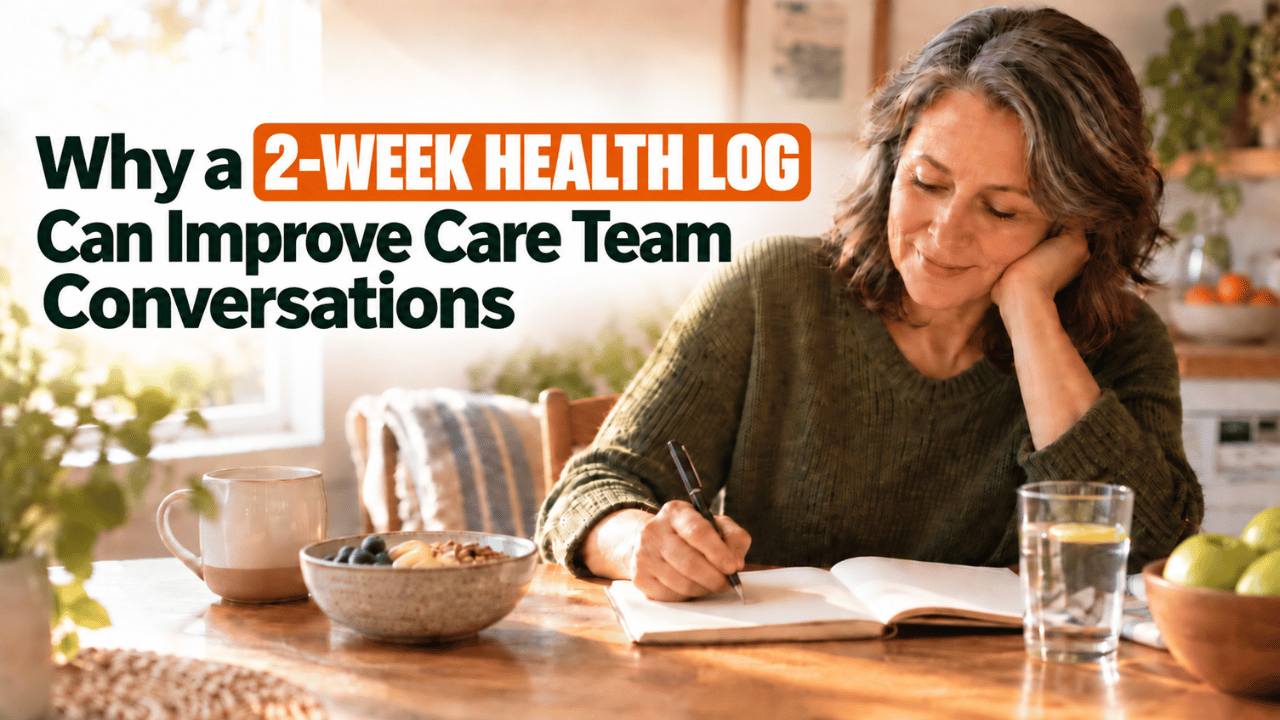
A diagnosis matters. It gives a name to what has been identified and can guide important treatment decisions.
But a diagnosis is data, not the full story.
It may not explain why some days feel harder than others. Why symptoms seem to fluctuate. Why your energy changes. Why sleep suddenly falls apart. Or whether there are patterns your care team simply cannot see during a 20-minute appointment.
That is where something surprisingly simple can help: two weeks of paying attention.
Your Care Team Sees a Snapshot. You Live the Whole Day.
When you are living with cancer, Parkinson’s or another neurological condition, metabolic disease, or another complex chronic condition, there can be a lot to remember.
When did the fatigue get worse?
Did the nausea start before or after a medication?
Were you sleeping poorly that week?
Had your appetite changed?
Was stress unusually high?
Trying to reconstruct all of that from memory during an appointment can be difficult, especially when you are already managing symptoms, medications, tests, and treatment decisions.
A short health log creates a record you can bring into the conversation.
Not to diagnose yourself.
Not to prove that one food, medication, or stressful day “caused” a symptom.
But to identify patterns worth discussing.
What to Track for Just Two Weeks
Keep it simple. You do not need a complicated spreadsheet or perfect measurements.
For 14 days, consider recording:
- Symptoms: What did you notice, when did it happen, and how intense was it?
- Medications: What did you take and when? Record only. Do not change doses or timing without your prescribing clinician.
- Meals: What did you eat, approximately when, and were there major changes in appetite?
- Sleep: Roughly how long did you sleep, and did you feel rested?
- Stress: Was the day relatively calm, moderately stressful, or unusually difficult?
You can also note anything that seems relevant to your situation, such as treatment days, movement, digestive changes, or unusual fatigue.
The goal is not obsessive tracking.
The goal is better information.
Patterns Are Clues, Not Conclusions
This distinction matters.
If you notice that a symptom repeatedly follows poor sleep, a particular meal pattern, a medication time, or a high-stress day, that does not automatically mean you have found the cause.
Human biology is rarely that simple.
But repeated observations can give you and your care team better questions to investigate.
For example:
“Over the last two weeks, this symptom was noticeably worse on these five days. Here is what else was happening.”
That conversation is very different from:
“I just feel worse lately.”
A log can help turn a vague experience into information that may be easier for your physician, specialist, dietitian, pharmacist, or other qualified healthcare professional to evaluate in context.
Your Diagnosis Should Not End the Investigation
At DNA Wellness, this is an important distinction:
A diagnosis tells us something important about your health. It does not automatically tell us everything influencing your health.
Two people can share the same diagnosis and have very different symptoms, medications, treatment histories, sleep patterns, nutritional needs, metabolic health, and daily challenges.
That is why context matters.
Dr. Laleh Talebian, Ph.D., approaches health as a molecular and cellular scientist: look at the information, identify meaningful patterns, ask better questions, and avoid pretending that a single observation explains a complex biological system.
You can respect appropriate medical treatment while becoming a more informed participant in your own care.
Sometimes that begins with nothing more sophisticated than a notebook and 14 days of observation.
One Simple Place to Start
If your two-week log makes you curious about the role your everyday meals may play in supporting overall health, the Healthy Plate Guide can give you a simple framework for thinking about balanced food choices.
Download the Healthy Plate Guide: https://dynamicnaturaladvantage.com/healthy-plate
Use it as education, not as a replacement for individualized nutrition guidance, especially if your diagnosis, treatment, medications, appetite, or medical condition affects what you can safely eat.
Educational Disclaimer: This article is for educational purposes only and is not medical advice, diagnosis, or treatment. Work with your qualified healthcare team for recommendations specific to your condition, and do not start, stop, or change medications without your prescribing clinician.
It’s time to stop guessing and start healing. Schedule your consultation today.
